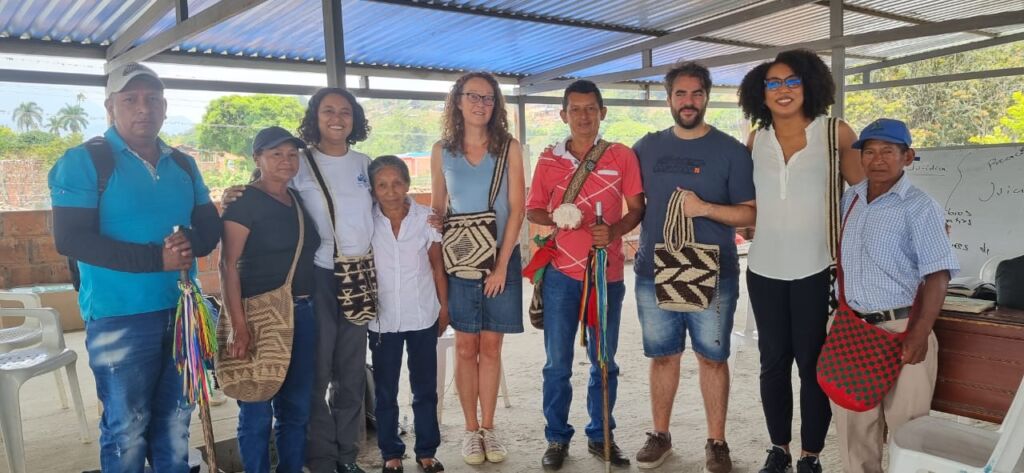
We are very pleased to announce the publication of ‘A Toolbox for a Decolonial Perspective in UCP’. This toolbox seeks to highlight key aspects that can support decolonization processes advocated by Unarmed Civilian Protection (UCP) practitioners. It’s not a definitive or closed document, but rather a dynamic and open proposal intended to expand through discussion and exchange within our community of practice.
This toolbox was developed in the context of the meetings of the Decolonization Working Group of the UCP Community of Practice, led by Nonviolent Peaceforce. The elaboration of the toolbox was supported financially and by team members of the Creating Safer Space network. The toolbox is available in English and Spanish:
Their work invites us to consider how the arts and heritage can contribute to our understanding of safeguarding and survival in a fragile context, but also how protecting the arts could be essential to creating a safer society.
Artists and keepers of cultural traditions from South Sudan, Sudan and Colombia have worked with researchers to investigate the ways we seek out protection and how those strategies for safety are narrated.
Four team members of the N+ project Art That Protects visited mid-Wales in October 2023. Project PI Beatriz Arias López and research assistant Laura Jimenez of the University of Antioquia were joined by project partners Adriana Diosa and Oscar Manuel Zuluaga of Harlequin and the Jugglers for an event at Aberystwyth University that showcased the work and findings of the project’s first phase. Read more about the event here.
Art That Protects team members at Aberystwyth University
In addition, Adriana and Oscar gave a theatre workshop for 3rd-year students of the Department of Theatre, Film and Television Studies (TFTS) and contributed to a seminar on dance as a form of resistance in Colombia in the Department of History and Welsh History. They also presented the Art That Protects project at the Community Hwb in Machynlleth.
Adriana and Oscar at the Community Hwb Machhynlleth
Creating Safer Space network participates in Geneva UCP Gathering
15 members of the Creating Safer Space network took actively part in an International Gathering of Unarmed Civilian Protection and Accompaniment Organisations, which was held in Ferney-Voltaire, France and Geneva, Switzerland from 9-11 October 2023. Organised by Nonviolent Peaceforce with input from a range of UCP/A stakeholders, this was “the first global gathering of UCP/A practitioners, their community partners, researchers and allies collaborating to advance the UCP/A Community of Practice by creating opportunities to grapple with shared issues, explore creative solutions, and build relationships with colleagues working around the world”.
Ten of the 15 N+ Creating Safer Space members who participated in the International Gathering in Geneva
N+ members – from the core network team, different project teams, and the advisory board – were involved in planning, implementing and facilitating the gathering, offered workshops on different UCP/A-related topics including decolonisation, learning and evaluation, looming threats, and peace processes, spoke about UCP and community self-protection research at a policy event for humanitarian organisations and UN member countries, and contributed to the gathering more widely by sharing their experiences and knowledges.
Ellen Furnari, Creating Safer Space advisory board member, played an essential role in the research and planning process that led up to this Gathering. Ellen together with core N+ team members Nerve Macaspac, Rachel Julian and Roger Mac Ginty organised a workshop on “Learning What Works in UCP/A”, while core team members Beatriz Arias López and Laura Jimenez were active in the “Decolonising UCP/A” process and workshop. South Sudan project team member Moses John contributed to the “Looming threats: Shaping challenges into strategies” plenary, and project PI Juan Mario Diaz led a workshop on “The Role of UCP/A in Contemporary Peace Processes”.
N+ Project PI Enrique Chimonja Coy speaking at the Policy Roundtable in Geneva
Project PI Enrique Chimonja Coy and Network PI Berit Bliesemann de Guevara contributed to a Policy Roundtable, co-hosted by the Permanent Missions of the Netherlands, Costa Rica, the Philippines and Sierra Leone to the United Nations and Nonviolent Peaceforce.
Other N+ members participating in different roles in the Gathering included project team members from or working in Colombia, Myanmar, and Indonesia, and Palestine. The Gathering was co-facilitated by Berit Bliesemann de Guevara and Beatriz Arias López.
The N+ team also organised a small preview of the Creating Safer Space exhibition, which involves creative outputs from our projects and will be shown in full in different locations around the world in 2024.
Learn more about the Community of Practice process and the Gathering here.
A small preview of the Creating Safer Space exhibition
Fieldwork in South Sudan uncovers cultural practices for early warning and conflict preparedness
Diria Vicky Thomas and Haji Elias, two researchers working with Community Aid for Relief and Development (CARD) and Lomore Development Organization (LDO), partnering Chas Morrison from Coventry University (UK), have been investigating cultural self-protection and conflict preparedness measures in South Sudan. They report on their findings:
“We have uncovered a huge range of cultural practices employed for early warning and conflict preparedness. These are generally distinct among different tribal groups in the country.
They tend to be traditional, hierarchical, procedural, formalised, low-tech, non-literate and highly divided along gender lines. They include use of tied grasses, ash circles, drumming/song, cursed water/goatskins/charcoal, prayers and fasting practices, and other spiritual defences/curses. We have collected examples of many such practices.
Briefly, symbols for early warning/preparedness are multi-purpose, used against different threat types (violence, ghosts, insects, floods etc), embedded in tribal identities, and conflate preparing for fighting with avoidance of violence. That is, avoiding conflict is not necessarily a goal in itself, but that violence should be carried out under strict demarcated lines and in accordance with tribal norms. As one village chief stated, “We prefer witchcraft protection, more than physical protection”.
UCP organisations and programming should be sensitive to such cultural practices, and embed them into formal structures and responses to violence. There is a clear division between traditional and formulaic practices of inter-tribe violence, and modern forms of violence which are associated with struggles for political power, criminality, and proliferation of small arms (rather than traditional spear, or bow & arrow).”
Men in South Sudan illustrating the use of grasses tied together to convey a specific symbolic meaning. When the heads of the grasses are tied together, it symbolises a clash (that there will be fighting). When the heads of the grasses are apart, as the man in the middle demonstrates with his hands, it symbolises that violence will be avoided.
Research Café: Top tips for publishing in academic journals
At the next Creating Safer Space Research Café, Dr Sukanya Podder will draw upon her experience as Deputy Editor of the academic journal Civil Wars to explain how the publishing process works, and to share some top tips for publishing in academic journals.
This session will be especially relevant to early career researchers, researchers working within practitioner organisations, and others who are new to publishing in academic journals. The session will finish with an open discussion, and we also warmly welcome senior researchers to come and share top tips of your own.
1.30 – 2.30 pm UTC on Monday 30 October Please use a timezone converter to check your local time.
The session will be held in English and Spanish with simultaneous translation.
The aim of this network-wide Creating Safer Space Research Café is to enable people in different parts of the world to exchange knowledge and to help build a community of Unarmed Civilian Protection (UCP) researchers and practitioners.
Findings of Ritualising Protection Project presented in Colombia
On 26-27 September, the Ritualising Protection Project (RPP) team convened, jointly with the indigenous authorities of the Resguardo Indígena de Huellas Caloto, a two-day workshop to present and discuss the findings of the Project. During the first day, the research team met with the indigenous authorities, elders, and some members of the community. During the second day, the findings were discussed with a member of the local ombudsman office (defensoría del pueblo). These discussions will feed into a draft policy document that will be published on the RPP website in the coming weeks.
The exhibition is a collective work between artists and researchers, displaying photographs, embroidery, music, cartoons and artistic installations to create a dynamic conversation between Colombia and South Sudan.
The exhibition concludes on Friday 27 October. More information is available here:
Thursday, 19 October 2023 Time: 10.30 – 12.00 Venue: Cinema, Aberystwyth Arts Centre
With:
Adriana Diosa and Oscar Manuel Zuluaga (Harlequin and the Jugglers, Colombia)
Beatriz Arias López and Laura Jimenez (University of Antioquia, Colombia)
Berit Bliesemann de Guevara (International Politics, AU)
Financed by the Creating Safer Space network, the research project “Art that Protects” looked at the impact of twenty cultural organisations who work with communities in the city of Medellín, Colombia, in areas which are highly vulnerable and affected by urban violence. The project showed the power of community art in this context. By strengthening social ties, erasing the invisible boundaries that divide neighbourhoods, and empowering marginalised groups, community art creates safer space for communities living amidst violent conflict. As a platform for the inhabitants of the neighbourhood to express themselves, to denounce, to undergo catharsis, and to resist, community-based art becomes the umbrella that protects civilians from violence and creates safer space for life.
This event combines the presentation of the project findings and short video clips from the project-based play “La Fiesta” with elements of live theatre and a discussion with the audience to explore the power of the arts to provide safer space in violent contexts.
The Creating Safer Space network has published a new working paper, ‘Unarmed Civilian Protection and Community Self-Protection in Colombia: A Literature Review’. The working paper is written by Laura Jiménez Ospina and Beatriz Elena Arias López at the University of Antioquia, and it is available in both Spanish and English.
The working paper draws upon 617 records that were collected, including academic literature, reports from civil society organisations and audiovisual material. The working paper explores literatures regarding the self-protection mechanisms that exist in Colombia and the communities that have used them; national and international NGOs that support human rights defenders and communities that live in contexts of violence; and other important discussions around UCP and self-protection.
All Creating Safer Space working papers are available here: