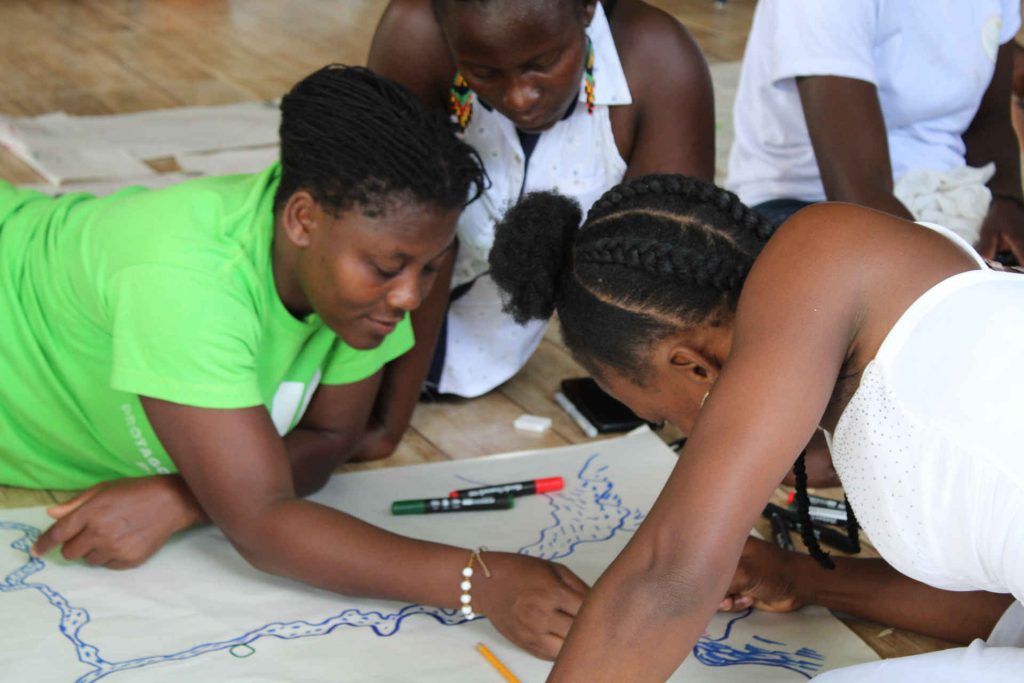


The social, political and armed conflicts that persist in the Bajo Cauca subregion of Antioquia (Colombia) have caused peasant and indigenous communities to develop their own protection mechanisms to confront the attacks suffered by their leaders at the hands of legal and illegal armed actors present in the territory. These protective actions have been linked with the Social Process of Guarantees of Antioquia (PSG), a platform of social and community organizations dedicated to strengthening internal community processes of self-protection and dialogue with the authorities responsible for guaranteeing safe conditions for the work of human rights defenders.
This research project systematized the experience of the PSG with the Senú indigenous people and peasant communities of the municipalities of Cáceres, El Bagre and Tarazá, as a mechanism for the unarmed protection of civil society that is contributing to the prevention of risks emanating from violent actions in the territory. The project identified factors that have influenced the success or failure of the strategies implemented by the PSG and the local communities, and has contributed to the production and dissemination of knowledge about collective unarmed protection mechanisms.
RESEARCH TEAM
- Astrid Torres Ramírez, Corporación Jurídica Libertad, Colombia (principal investigator)
- Winston Gallego Pamplona, Corporación Jurídica Libertad, Colombia (co-investigator)
- Fundación Sumapaz, Colombia (project partner)
- Antioquia Node of the Coordination Colombia Europe United States, Colombia (project partner)
PROJECT OUTPUTS
Publication: El Proceso Social de Garantías de Antioquia, Colombia: Una experiencia de protección civil no armada con comunidades indígenas y campesinas del Bajo Cauca antioqueño (Spanish only)

Short Film: Caring for Community Life
The Senú indigenous people of the Almendros 2 reservation in El Bagre, one of the municipalities hardest hit by armed violence in Colombia, tell how they have been organizing to resist armed groups and remain in their ancestral territories.
Project Website
Publications, posters, podcasts, photos, and more.

RESEARCH SUMMARY
The situation for social leaders, peasant leaders, human rights defenders, and indigenous authorities in Bajo Cauca, Antioquia, is alarming. The communities of this region are trapped in the middle of a social, political and armed conflict that is worsening. This is due to the territorial advance of armed groups who seek control of their territories, economies such as drug trafficking and illegal mining (not including traditional artisanal mining), and the presence of megaprojects. These circumstances have increased the risk for social leaders who, hand in hand with their communities, have had to face threats to their territories and lives. The limited presence of the State and the lack of basic services such as health, education, and housing have made the situation even worse.
The framework of impunity, in which the various attacks and patterns of crime have taken place, has generated a climate of fear and mistrust in the population, who live in constant fear of being a victim in their own territories. Human rights violations, attacks on social leaders, gender-based violence, forced disappearances, homicides, threats, and even extrajudicial executions continue to be reported in the subregion.
Peasant and indigenous organizations have therefore taken the initiative and have developed and implemented a series of self-protection measures to protect the life of their communities and their permanence in their territories. These measures include the creation of early warning systems to detect the presence of legal or illegal armed groups and to prevent the occurrence of attacks against the community, the creation of indigenous guards, the organization of walking tours to delimit and protect the territory, so-called word circles to share experiences, humanitarian shelters, and women’s committees, among others. This, together with spaces where peasant leaders and indigenous authorities can meet and train, have allowed them to respond to the threats and to protect themselves despite the absence of the State.
The organizations have also established alliances with other communities and civil society organizations to strengthen their response capacity. The have created solidarity, support and communication networks between the different communities, established evacuation routes in case of emergency, and some platforms such as the PSG have provided psychosocial support and have facilitated political advocacy work with government entities and the international community. Through these self-protection measures, peasant and indigenous communities are seeking to guarantee the safety and integrity of their members.
Within indigenous communities, strategies aimed at strengthening their protection, culture, ancestry, and knowledge are of high importance. They are based on the spiritual relationship of their communities with the land and the legacy and ancestral knowledge of the elders of the Senues, Embera Chamí, and other indigenous peoples, as a way to protect identities and to confront the violent actions of legal and illegal armed actors, who are present in the territories and commit serious violations of human rights and of international humanitarian law. Their unarmed civilian protection strategies are based on their own forms of indigenous governance and their own protection mechanisms such as the indigenous guards and the word circles. Self-governance has become a significant method of unarmed civilian protection for indigenous communities, since it enables them to exercise control and organize the order and defense of their territory and their common goods, to preserve culture, ancestry, and spirituality, to provide justice and education, to exercise the right to autonomy, to defend their rights as historical peoples, and to protect life and integrity. Based on their self-determination and autonomy, they make decisions in accordance with their culture, norms, practices, and customs in the face of humanitarian crises and the risks they face.
Given the serious humanitarian situation in Bajo Cauca, Antioquia, national and local authorities need to urgently take concrete measures to protect the communities and guarantee their fundamental rights. It is necessary to give special attention to the victims of the conflict, to investigate and punish those responsible for human rights violations, and to implement public policies that promote the sustainable development of the region while taking into account peasant organizations’ and ethnic communities’ demands and ideas.
In view that the State has so far failed to regulate the violence or to establish routes to protection, it should now enforce and implement changed collective protection models, which are not based on militarization and which recognize the experiences of communities and organizations (such as decree 660 of 2018 “Comprehensive Security and Protection Programme for Communities and Organizations in the Territories), and develop further safety provisions.
This research contributes to knowledge on successful unarmed civilian protection practices and improves those practices that have proven to be less effective. It shows that, by collecting and analyzing information on different self-protection strategies and measures, patterns and trends can be identified that contribute to a greater understanding of community safety systems. In this way, a more comprehensive and effective approach can be developed to protect the population in emergency situations. Furthermore, by continuing to link and systematize diverse experiences, memories, and forms of collective action, unarmed civilian self-protection practices can be improved, ensuring that the best practices are implemented and adapted to the specific needs of each community. This translates into greater preparedness to face armed conflicts and other risk situations, which in turn can save lives and reduce material damage.
NEWS
- More information about the research team’s engagement event in 2024 is available here.
- More information about the research team’s fieldwork in 2023 is available here.
WEBSITE AND SOCIAL MEDIA
- Project Webpage: https://cjlibertad.org/psgbajocauca/
- Organisation Website: https://cjlibertad.org/
- Twitter: https://twitter.com/cjlibertad
- Facebook: https://www.facebook.com/corporacionjuridicalibertad
- Instagram: https://www.instagram.com/cjlibertad/