New work package: Introducing UCP in Thailand

The Creating Safer Space network is pleased to announce a new work package on the following topic:

Introducing Unarmed Civilian Protection in Thai Society: Opportunities and Challenges

The work package is led by Chantana Wungaeo (Chulalongkorn University), in collaboration with Mark Tamthai (Strategic Nonviolence Working Group, Thailand)

More information about the work package is available on our website: https://creating-safer-space.com/introducing-unarmed-civilian-protection-in-thai-society-opportunities-and-challenges/


15. How do we complete the ‘Case for Support’?

Please address each of the topics listed on the Application Form. You are welcome to structure your answer in any way you prefer, but it is often helpful to use the topics as subject headings, and to cover each in turn – that way, you are less likely to forget anything important.

The aims of the project.

The principal aims of the project are the overarching purposes of your research (what it is trying to achieve in terms of knowledge and what the potential impacts of this are). Aims are often provided as a short list.

The research question(s) or problems, the research context, and the project’s contribution to knowledge.

What are the research questions, issues or problems that you will be exploring in the course of your research? Why is it important that these questions or issues are explored? What other research has been conducted in this area, and how will you contribute new knowledge? What contribution will your project make to enhancing creativity, insights, knowledge or understanding in your chosen area of study? To whom will the outcomes of your research be of particular interest (academically and practically)?

The UCP database is a user-friendly way of finding the latest research on UCP, including academic research, working papers and NGO documents. You can easily search the database using keywords or specific regions and countries.

The relevance of the project to the Creating Safer Space network, and how it contributes to our understanding of unarmed civilian protection and self-protection in the midst of violent conflict.

We will only fund projects that are directly relevant to the Creating Safer Space network, and specifically, to understanding unarmed civilian protection and self-protection in the midst of violent conflict. Explain the relevance of your project carefully, and explain which of the three research themes listed in the Call Specifications your project will address and how.

The research design and methods.

What research methods will you be using to address the questions or issues that you have set yourself, or solve the problems you have identified? Why have you chosen these methods? Why are they the best way to answer the research questions or problems you have identified?

Please describe the research design and methods in detail. For example, if you have chosen to conduct interviews: How many people are you hoping to interview? How will you select and approach participants? How will you ensure representation of different groups in the community (e.g. different genders, ages, ethnicities, religions)? How will you conduct the interviews? How will you analyse the data?

The role of each team member and project partner.

What will be your role, and what expertise or experience do you bring to the project? What will be the roles of other researchers or project partners, and why are they the appropriate people or organisations to be involved?

How the project will be managed, the work plan and timelines.

How will the project be managed? What is the timetable for the project? Does it include appropriate milestones and is it realistic? When will the outputs of the project be completed?

If a research assistant is to be employed, you should state clearly the nature of the work they will be undertaking and describe the working relationships that are envisaged between all the members of the research team. You should describe fully the arrangements for supervising and managing the research assistant. If the researcher is unknown, you should state the skills and qualifications sought.

If a contracted researcher or consultant is to be hired, please describe the proposed arrangements in detail.

The Creating Safer Space network strongly encourages projects to provide development opportunities for research staff (especially early career researchers). For example, will they receive relevant training, the opportunity to present at conferences, or the opportunity to (co-)author publications? We encourage projects to budget development opportunities for research staff into the proposal.

The project’s planned outputs, dissemination strategy and beneficiaries.

You should address two main questions: who might benefit from the research and how might they benefit?

Please consider both academic and non-academic beneficiaries of your project. Are there researchers within your own research area, or in other academic disciplines, who will benefit from your research? Will specific communities living in the midst of violent conflict benefit from the research? What about policymakers at different levels, or humanitarian organisations working to protect people from violence? What will you do to identify additional potential beneficiaries as the research progresses?

How will these people or organisations benefit from your research? What will you do to engage with them, and what will you do to ensure potential benefits are realised? For example:

  • If your project has the potential to benefit researchers in the field of Peace and Conflict Studies, in what ways will they benefit – why will the research be interesting to them? What will you do to ensure they find out about the research? Will you present your research at a relevant academic conference? Will you publish the research in an academic journal, and if so, do you have a target journal in mind?
  • If your project has the potential to benefit a community living in the midst of violent conflict, in what ways will they benefit – how can the research findings improve their situation? Will you engage with them at an early stage, to find out what they hope to get out of the research? What will you do to ensure they find out about the research outcomes? For example, will you present the research at a community workshop, or will you produce a video recording in the local language, to explain the research? Will you engage with community groups to help them implement any findings?

Please see Question 13 in these FAQs for detailed guidance.

How the project includes some elements of the arts and humanities.

Our project is funded by the Arts and Humanities Research Council, and it is a requirement of all projects to include some elements of the arts and humanities. Please describe how your project meets this requirement, and see question 12 for further guidance.

Any other important information in support of the project, which is not covered elsewhere on the application form.

While you are welcome to include additional relevant information, please think carefully about whether the information is relevant and important. For the most part, the questions on the application form will be the questions that interest the Funding Panel.

Next FAQ

Back to FAQ overview


Research Café: The Everyday Peace Indicators Project

The aim of the Creating Safer Space Café is to enable people in different parts of the world to exchange knowledge and to help build a community of Unarmed Civilian Protection (UCP) researchers and practitioners.

This month, Prof. Roger Mac Ginty (Durham University, UK) will present on the following topic:

The Everyday Peace Indicators Project: A Bottom-Up Approach to Design, Monitoring, Evaluation and Learning, and its applications to UCP.

12.30 – 1.30 pm UTC on Thursday 18 November.

The session will be held in English and Spanish with simultaneous translation.

All welcome. Please contact creating-safer-space@aber.ac.uk for the Zoom joining details.


16. How do we complete the ‘Ethics and Safeguarding’ section?

Please address each of the questions on the Application Form.

What are the ethical challenges and implications arising from the proposed research, and how will they be addressed?

Every project will face unique ethical challenges, so please think carefully about ethics in the context of your own research. Further guidance on research ethics is available on our website in the document ‘Research Projects – Ethics (p. 2-8). Please speak with experienced academic colleagues for advice on how to address ethical challenges in the context of your own project.

How will you ensure that the research undergoes appropriate ethical review?

All projects must secure ethical approval from an appropriate institution before research can begin. For example, universities normally require their researchers to submit an application for ethical approval to an Ethics Officer or Research Director, who reviews the research plans to ensure they conform to internationally and locally accepted ethical guidelines. The reviewer can approve the project, or they can require the research team to adopt different ethical practices. In some circumstances where the research raises high-risk ethical issues, it can be referred to a Research Ethics Panel for approval.

You can apply for ethical approval after the project has been awarded funding, if this is in line with your own organisation’s processes, but the process must be completed before the research begins.

In the application form, you must describe how you will ensure that the project undergoes appropriate ethical review. Will you submit an application at your own organisation for ethical approval, and if so, what are the processes? If the project is awarded funding, we will require evidence to confirm that the ethical review processes are appropriate.

If your own organisation does not have processes for ethical approval, you will need to ensure that the project will be able to undergo ethical review at another organisation. Does your project include Co-Investigators or Project Partners? Would it be possible for the project to undergo ethical review at their organisation?

What measures will you take to ensure the safety and wellbeing of project staff, research participants, or any other people involved in or impacted by the project?

Please think carefully about safety and wellbeing in the context of your own project, and please see the Creating Safer Space Safeguarding Policy (available soon on our website) for potential questions and issues to consider. For advice on how to develop fair and equitable research projects and partnerships, please read the Global Code of Conduct for Research in Resource-Poor Settings.

Next FAQ

Back to FAQ overview


Privacy Policy

This page outlines the range of data the Creating Safer Space network collects when you visit and interact with this website.

Our website cookies

Anonymous visitors: this is all visitors who do not log into the website with a user account. When a visitor arrives they are asked whether they accept cookies. In order to prevent re-asking on every page load, a cookie is set to avoid this. Consent may be withdrawn at any point by using the “Privacy Settings” tab at the bottom of the browser window.

Logged in visitors: this is anyone who accesses the website with a user account. A session cookie will be set when you log in, this is in order to retain your logged-in status when loading new pages.

Third-party cookies and data sharing

This website uses Google Analytics to gather anonymous statistical data for the purposes of providing the Creating Safer Space network with an overview of visitor demographics. Their latest privacy policy can be found here: https://policies.google.com/technologies/partner-sites

Embedded content from other websites

Articles on this site may include embedded content (e.g. videos, images, articles, etc.). Embedded content from other websites behaves in the exact same way as if the visitor has visited the other website. These websites may collect data about you, use cookies, embed additional third-party tracking, and monitor your interaction with that embedded content, including tracking your interaction with the embedded content if you have an account and are logged in to that website. We have no control over, and assume no responsibility for the content, privacy policies, or practices of any third-party sites or services.

Newsletter

If you subscribe to our Newsletter, we collect your name and email address, and store the information securely at Aberystwyth University. We will use this to distribute information about Creating Safer Space events, activities, funding opportunities and other relevant news. Under data protection legislation, the legal basis for the collection and use of your personal data is consent. You may unsubscribe to the newsletter at any time by contacting creating-safer-space@aber.ac.uk, and we then delete your personal data. If you do not unsubscribe, we keep your personal information for as long as the Creating Safer Space research network is active, and we will then dispose of your information by deleting your data. The data controller is Aberystwyth University, and our contact details are available below.

Changes to this Privacy Policy

We may update our Privacy Policy from time to time. Thus, we advise you to review this page periodically for any changes.

Our contact details

Creating Safer Space Network
International Politics Department
Aberystwyth University
Penglais
Aberystwyth SY23 3FE, UK

Email: creating-safer-space@aber.ac.uk

Aberystwyth University’s Data Protection Officer: infogovernance@aber.ac.uk


Introducing Unarmed Civilian Protection in Thai Society: Opportunities and Challenges

Excerpt from the Visual Note Summary

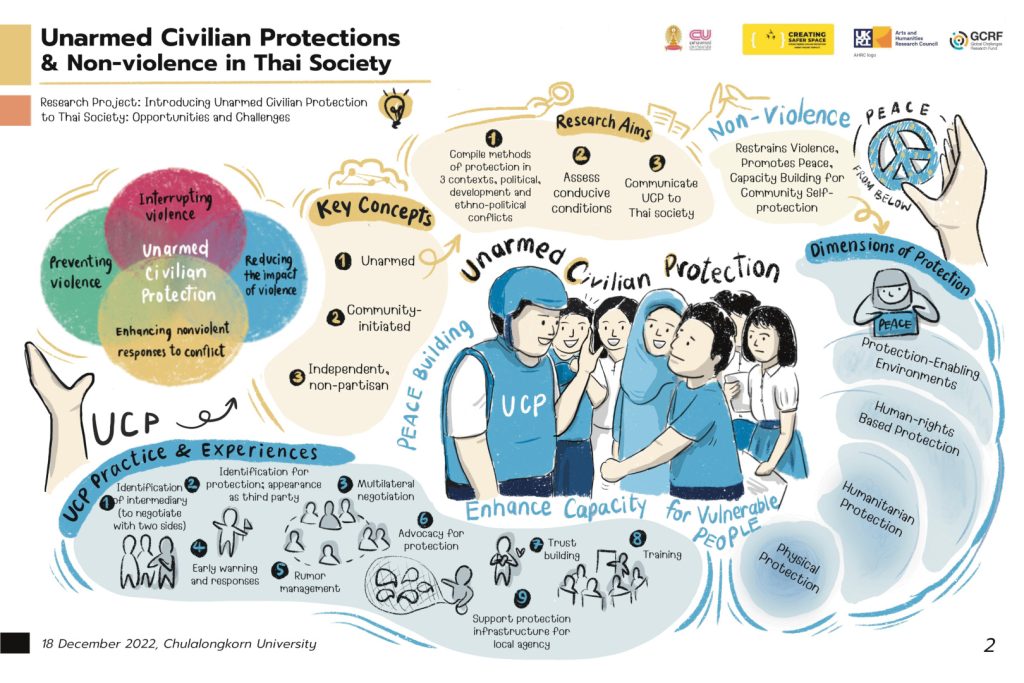
Thailand is a country that is presently experiencing different kinds of violence, from the low-intensity conflict in the Deep South, to violence surrounding political protests, and to environmentally based conflicts with tribal ethnic groups. The state’s application of emergency law, martial law, national security law, and the persistent impunity in the security sector, have resulted in a situation in which protection mechanisms by the state are not adequate.

This research had the following questions/objectives:

  1. To demonstrate that protection of civilians can also be done by civilians, and that unarmed protection can be learned.
  2. To explore the opportunities and challenges of UCP practices in the Thai conflicts and political context.
  3. To reiterate that UCP is part of conflict management and nonviolent struggle.
  4. To compile, define, and analyse patterns of civilian protection practices in various conflict situations.
  5. To identify the conditions and the social and political environments affecting UCP practices.
  6. To design communication channels and a social learning platform for UCP.

RESEARCH TEAM

  • Chantana Wungeao, Peace and Conflict Studies Center, Chulalongkorn University, Thailand (principal investigator)
  • Mark Tamthai, Strategic Nonviolence Working Group, Thailand (co-investigator)
  • Nonviolent Peaceforce Philippines (project partner)

RESEARCH OUTPUTS

Series of Policy Briefs (Thai only)

Policy Brief 1: The UCP Idea

Policy Brief 2: Opportunities & Challenges

Policy Brief 3: UCP and Nonviolence

Visual Notes

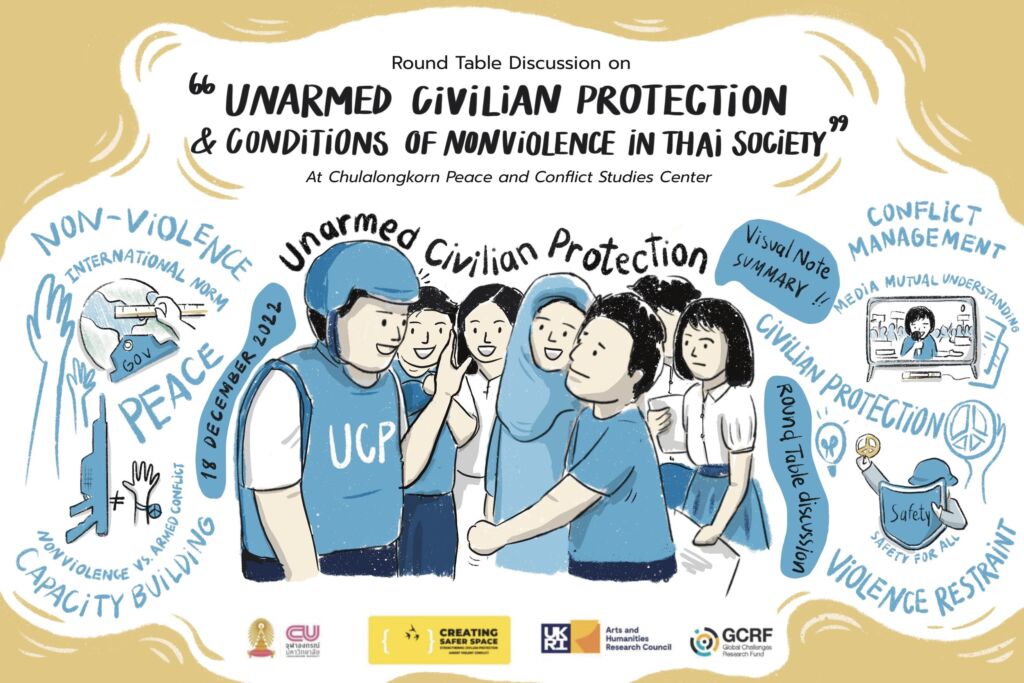
A visual note summary of the roundtable discussion “Unarmed Civilian Protection and Conditions of Nonviolence in Thai Society” at Chulalongkorn Peace and Conflict Studies Center, December 2022. Illustrated by Wanwisa Intarakanchit.

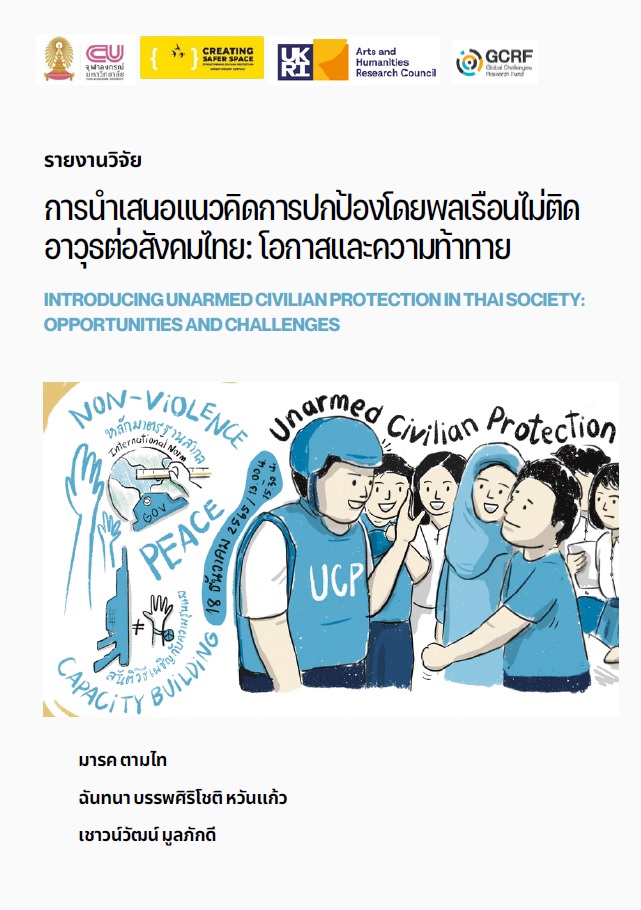
Report: Introducing Unarmed Civilian Protection in Thai Society (in Thai)


Art that Protects, phase 1: Contributions of artistic-cultural initiatives to the self-protection strategies of young people and women in the context of the urban conflict in Medellín, 2022

Harlequin and the Jugglers (photo: Raul Soto)

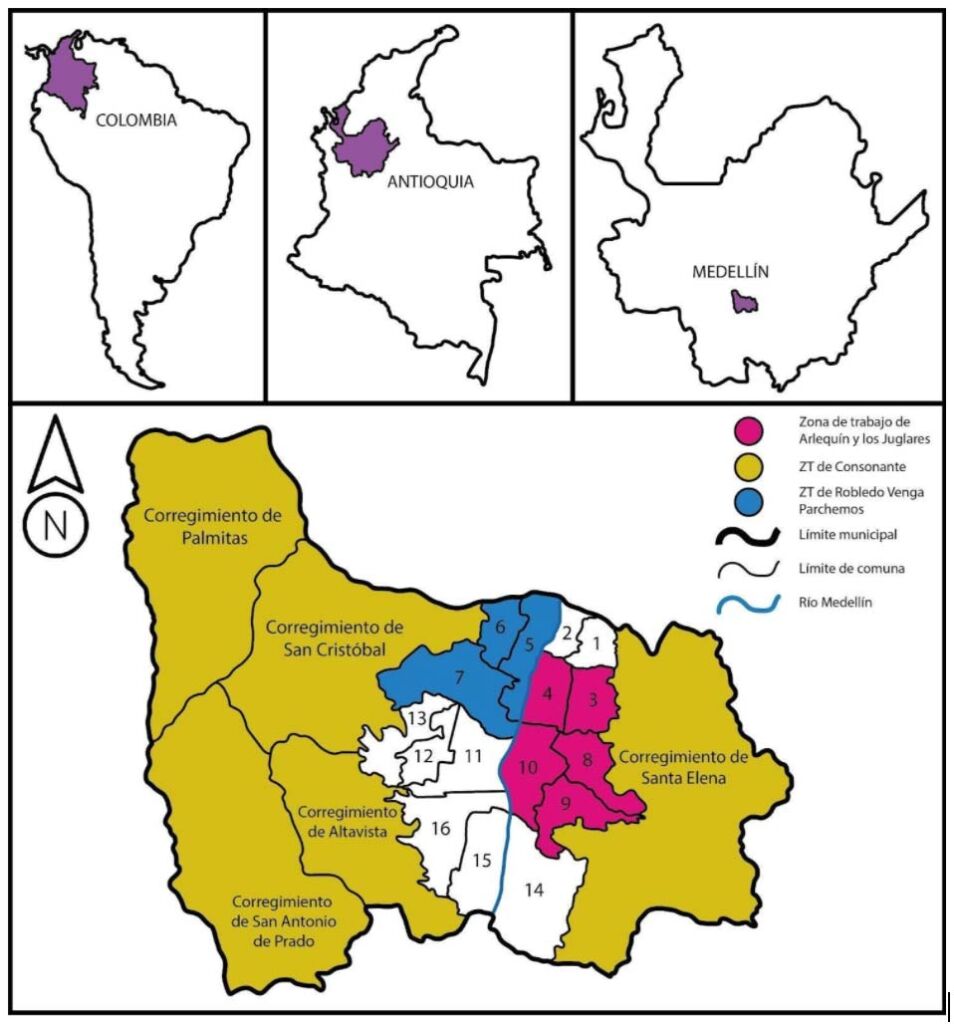
This project focused on two issues less explored in the existing literature on civilian self-protection: first, how forms of self-protection are related to urban conflict-related violations, with an emphasis on women and youth; and second, what place and meaning artistic and cultural practices developed by community-based organisations take in forms of self-protection. The research was carried out in the city of Medellin, Colombia, in collaboration with artistic and cultural organisations active in neighbourhoods affected by urban violence (central, north-eastern and north-western communities, as well as peri-urban districts). Exploring these questions allowed us to re-dimension the concept of civilian self-protection and its strategic possibilities for a better living of urban communities.

RESEARCH TEAM

  • Beatriz Arias López, Universidad de Antioquia (principal investigator)
  • Adriana Diosa, Cultural corporation for development Arlequín y los Juglares
  • Giovanni Pérez Cárdenas, Cultural corporation for development Arlequín y los Juglares
  • Katherne Urrea Velásquez, Robledo Venga Parchemos
  • Jeimy Catalina Guerra Correa, Corporación Consonantes

PROJECT OUTPUTS

Recording of La Fiesta theatre production, performed at Pablo Tobón Uribe Theatre of Medellín on 17 May 2023 (more information in English and Spanish). La Fiesta is written by Óscar Manuel Zuluaga and performed by Harlequin and the Jugglers.

Arte Que Protege music video by Gio Monteadentro.

Art: A social outburst song and video, introducing the context of the research project. For translation of the video, please choose first Spanish subtitles (click on the cog symbol) and then your language by clicking on auto-translate.

Article in Estudios Políticos

Alfaya Cardona, Laura, Sandra Benítez Diosa, Laura Jiménez Ospina, Freddy Giovanni Pérez Cárdenas, ‘Vulneraciones y riesgos de mujeres, niños, niñas y jóvenes involucrados con las actividades de organizaciones de base artístico-culturales en el contexto del conflicto urbano en Medellín, 2022′ [Infringements and Risks of Women, Children and Youth Involved with Activities of Grassroots Artistic-Cultural Organization in the Context of Urban Conflict in Medellin, 2022], Estudios Políticos (Universidad de Antioquia), 70, pp. 108-132.

Article in Humanitarian Exchange

Arias López, Beatriz E., Laura Jiménez Ospina, Freddy Peréz Cardenas G., and Berit Bliesemann de Guevara, Art That Protects, Humanitarian Exchange, 82.12 (2023).

FIND OUT MORE

El Colombiano, “En Medellín el arte es barco y faro al mismo tiempo” (“In Medellín art is both ship and lighthouse”)
https://www.elcolombiano.com/cultura/arte-urbano-como-herramienta-de-autoproteccion-en-medellin-JG21638155

“The Network was invited to La Fiesta”.
Spanish: https://creating-safer-space.com/la-red-estuvo-invitada-a-la-fiesta/
English: https://creating-safer-space.com/the-network-was-invited-to-la-fiesta/

UdeA Noticias, “Cuatro murales, huellas del arte que protege en Medellín” (“Four murals, traces of the art that protects in Medellín”)
https://bit.ly/ArProUdeA

Tele Medellín Note: Art transforms and protects
https://a.hallon.es/view_pdf.php?sid=18202&cid=954690271

Medellín DNA: Behind the traces of art that protect lives in Medellín
https://p.hallon.es/view_pdf.php?sid=18202&cid=954713518

PHASE II

This project has led to a second continuation phase. Read more about Phase II.

MAP OF THE RESEARCH AREA

Map of the research areas (based on interviews with project partners)

Harlequin and the Jugglers

Colombia

Harlequin and the Jugglers is a theatre and puppetry group dedicated to the performing arts. We have been working alongside social, popular, cultural, human rights, and community organizations, bringing messages of hope and life, strengthening organizational processes, providing work tools through art and contributing to the construction of a democratic, equitable and just society.

Links with further information:

Website: http://arlequinylosjuglares.org/ 

Facebook: https://www.facebook.com/arlequinylosjuglares 


Nonviolent Peaceforce Myanmar

Myanmar

Nonviolent Peaceforce is a global non-profit organization. We protect civilians in violent conflicts through unarmed strategies. We build peace side-by-side with local communities. We advocate for wider adoption of these approaches to safeguard human lives and dignity.

Key individuals involved in the Creating Safer Space research network Rosemary Kabaki and Ashish Panday

Links with further information:

Website: https://www.nonviolentpeaceforce.org/

Facebook: https://www.facebook.com/nonvpf/

Instagram: https://www.instagram.com/nonviolentpeaceforce/?hl=en 

Twitter: @Peaceforce


Centre for Development and Ethnic Studies

Myanmar

The Centre for Development and Ethnic Studies (CDES) is an independent think tank and study centre founded in 2012 to generate ideas on democracy, human rights and federalism as an effective vehicle for “Peace and Reconciliation” in the Union of Burma/Myanmar.

Facebook: https://www.facebook.com/CDES.centre