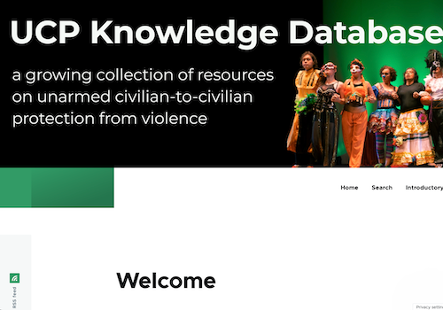
Re-launch of the UCP Knowledge Database

The former UCP Research Database is now the UCP Knowledge Database!

Developed by Creating Safer Space and hosted by UCP Academy, the revamped UCP Knowledge Database is the biggest public repository on Unarmed Civilian Protection, community self-protection and related topics. It includes academic research publications, working papers, NGO documents, films, music, and more, and is now available on a user-friendly, open access platform. 

We hope you you enjoy browsing through the database and find it useful to your work!

We need your input!

We seek to continuously grow and improve the UCP Knowledge Database, and to do so, we need your input:

  • Are there UCP resources missing which should be included?
  • Do you, or does your organisation, hold resources that could be made available through the database?
  • Can you help pointing out UCP-related resources in languages currently under-represented (or not at all)?
  • Any other constructive feedback?

Please send your input to: creating-safer-space@aber.ac.uk.


Youndé practitioners workshop on community-led UCP in Cameroon

The Cameroon team organised a practitioners workshop in Yaoundé on 19 March 2025, entitled ‘Strengthening Community-Led Approaches to Unarmed Civilian Protection in Cameroon’.

The event was held at the Friedrich Ebert Foundation office and attended by 30 representatives of local, national and international NGOs and diplomatic officials. The aim was to share research, experiences and brainstorm on ways to strengthen community-led nonviolent approaches to protection in Cameroon.

The Cameroon team presented their findings to the audience, stimulating a discussion about unarmed civilian protection in the Cameroonian context and Africa more generally. A Practitioners’ Roundtable involved representatives from Peacebuilders International (PBI), International Committee of the Red Cross (ICRC) and two local women’s organisations working on protection who presented their work on civilian protection in Cameroon and elsewhere.

The workshop concluded by formulating a joint media statement and call to action in French and English.

The workshop was funded through Coventry University’s ESRC/IAA Impact Funding award.


New Policy Briefs on Violence and Protection in Rakhine State, Myanmar

The project team of “Exploring Community Perceptions and Coping Strategies on Violence in Rakhine State, Myanmar” has published two Policy Briefs, on perceptions of violence and of nonviolent civilian protection in Myanmar’s Rakhine state.

Policy Brief No. 1, “Perceptions of Everyday Violence in Rakhine State, Myanmar, examines years of civilian-targeted violence that occurred in central and northern Rakhine. At its core, the Rakhine conflict is an asymmetric conflict involving the national military (Sit-Tat) and factions of several local ethnic insurgency groups, prominently the Arakan Army. Contestation to assert local control across Rakhine has exposed the population of diverse ethnic and religious backgrounds to different facets of violence. This ranges from direct violence attributable to armed clashes to subversive forms of violence rooted in systemic discrimination and a culture of hostilities targeted at certain ethnic groups. Discussion with respondents reveals a population in distress, losing hope and feeling isolated.

Policy Brief No. 2, “Perceptions of Nonviolent Civilian Protection in Rakhine State, Myanmar, presents the project team’s findings on local conceptions of nonviolent protection in Rakhine State. Participants’ responses suggest that locals primarily need to invest in their capital as individuals (e.g., wealth, ethnicity, social standing, knowledge, and others) to gain access to different self-protection strategies. Yet access to such capital is largely driven by ethno-religious privilege, which puts the ethnic minority groups at the struggling end. Alternatively, there are chances of local protection efforts being provided by other stakeholders such as sangha (Buddhist monks), prominent local figures (i.e., village elders and local administrators), and locally operating humanitarian groups, but such efforts are currently limited and are highly context-specific. The policy brief concludes with some key recommendations on how to better expand access to civilian personal capitals for all Rakhine ethnic communities and what sort of support unarmed third parties may need in order to better prepare their interventions.


New journal article “Art That Protects”

Beatriz Arias López and Laura Jiménez Ospina, of the project “Art That Protects“, have published a new open-access article under the title “Art that protects: Contributions to expanded self-protection in the urban socio-political conflict in Medellín, Colombia” (in Spanish) in the journal Revista Virtual Universidad Católica del Norte.

Summary: Previous experiences and studies agree that art is a powerful mediator in contexts of socio-political violence. The aim of the study was to explore how artistic and cultural initiatives developed by community-based organisations in Medellín generate and facilitate self-protection strategies, especially for women and young people in the context of urban conflict. From 2022 to 2024, our team conducted an in-depth case study including document analysis, participant observation, territorial walking tours, semi-structured interviews, and discussion groups, with the participation of 15 organisations. It shows that art becomes self-protective through its impact on strengthening collective processes, mutual recognition, the ownership of safe territories, and the possibility of an affirmative stance by artists and communities towards armed actors, making art a protective umbrella that enables other types of relationships and agency in the neighbourhood, in addition to the legitimacy built by organisations over the years. The authors conclude that art allows for expanded self-protection that encompasses both a physical and emotional dimension, considering the bonds that are formed between individual and collective bodies, with actions of care that strive to maintain and strengthen solidarity and spaces for the common good.

The article can be downloaded here.


CSS researchers in podcast on “Civilian agency, armed groups and international law”

Several Creating Safer Space project researchers contributed to the series “Civilian agency, armed groups and international law” of the Beyond Compliance: In Conversation Podcast, which is co-hosted by CSS project team member Florian Weigand together with Katharine Fortin.

In Episode 4, “Negotiating with Armed Actors”, Riyad Anwar and Abellia Anggi Wardani of the project “Exploring Community Perceptions and Coping Strategies on Violence in Rakhine State, Myanmar” talk with Ashley Jackson and the podcast hosts about their research on civilian agency during the armed conflicts in Myanmar and Afghanistan, respectively, asking: How do civilian communities negotiate with armed groups? What do people try to achieve in these negotiations? And what enables them to negotiate with an armed actor?

In Episode 11, “Civilian Self-Protection and Land”, Marwan Darweish and Piergiuseppe Parisi of the projects “Enhancing unarmed civilian protection amongst Palestinian communities in the South Hebron Hills” and “‘Ritualising’ protection in conflict” talk with the podcast hosts about their research on the different ways in which civilian communities resist against armed actors in Colombia and Palestine, asking: How does a community’s relationship with the land they live on feed into their experiences of harm? What solutions do they find to protect themselves?

In Episode 7, “Victimhood & Everyday Peace”, CSS co-investigator Roger Mac Ginty discusses with Kieran McEvoy and the hosts about Northern Ireland and their research on civilians navigating armed conflicts across the world. What role did civilians play during the conflict and peace process in Northern Ireland? How does agency relate to victimhood and transitional justice? And how can people contribute to ‘everyday’ peace?

The Podcast Series features a range of other interesting discussions will well-known researchers in the areas of civilian protection and civilian agency in conflict, and we highly recommend delving into it!


Shadow to Strength: New documentary, panel discussion, and art clips

In December 2024, the project “Nonviolent Artivism Against Police Brutality in Kenya” held a powerful exhibition, performance and panel discussion event at the Kenya National Theatre in Nairobi.

“Shadow to Strength: Resilience in the Face of Adversity” brought together artists, activists, survivors, and experts to discuss questions of human rights advocacy against police brutality in Kenya, which will also resonance with the experiences of many other communities around the world.

You can now watch highlights of this events in the “Shadow to Strength” documentary, the recording of a very insightful panel discussion on artivism against policy brutality, and in a series of art clips showcasing performances by Kenyan artists.


Shadow to Strength: Panel discussion on artivism against police brutality

This panel discussion on artivism for human rights and against police brutality took place as part of the exhibition and performances event “Shadow to Strength: Resilience in the Face of Adversity”, which took place at Kenya National Theatre in Nairobi in December 2024.

It is an output of the project “Nonviolent Artivism Against Police Brutality in Kenya“.


Shadow to Strength: Exhibition and performance highlights

This series of short videos captures some of the artistic highlights from the exhibition and performances “Shadow to Strength: Resilience in the Face of Adversity”, which took place in Nairobi, Kenya, in December 2024.

Nile Dawta

Event participants experienced Nile Dawta’s transformative Neo-Reggae sound as she performed tracks from her celebrated projects, blending art and activism. With a track record as a musician and gender advocate, Nile Dawta uses her artistry to drive social change. She has won the UN-Human Rights Art Competition and the Brazilian Young Talent Africa Music Awards, solidifying her position as a pioneer in East Africa’s Neo-Reggae movement.

Rebian Artis

Rebian Artis is a dynamic spoken word artist, writer, and activist who champions for equality, social justice, and human rights. Rebian has captivated audiences at @missingvoiceske, Usawa Festival, @mashujaafestival and beyond. Her powerful performances and words ignite conversation and inspire change.

Felicity Mudis

Felicity Mudis is an activist who uses spoken word and fashion. She cofounded with Aikos an initiative called Freedom In Healing that advocates for gender equality, mental wellness, and the eradication of sexual violence and other violations against women and girls through the power of art and media. She is passionate about spreading life and light through her work and has performed on a number of stages including @tedx_official, Jumuika Sikika Mtaani, Mask Awards, @hourpoetic , Poetry Cultural Exchange Uganda, the Annual SRHR and climate change Summit. She is the convener of @sisterdarlingmovement, an annual poetry event that focuses on telling the stories of African women for social change and raising emerging female poets.

A-zee Coptel

The exceptional Urban Sheng Hip-Hop artist and curator A-zee Copter is known for his distinctive vocal style and powerful storytelling. A-zee Coptel brings a unique blend of personal experiences and social commentary, making waves in Nairobi’s Embakasi area. He has collaborated with renowned artists like @julianikenya and @poetteardrops, fusing Afro, zouk, and R&B influences into his vibrant sound. Catch him on stages like Mukuru Festival, Pawa Cafe, Form Ni Gani Concert, Mashujaa Festival, and Good Governance Festival.

Spontaneous the Poet

Spontaneous the Poet is an award-winning spoken-word artist, artivist, and cultural curator with over a decade of impactful experience. Honoured with accolades such as the Africa Women Journal Awards (2023) by @femnetsecretariat, she co-directed the best-spoken word production, Give The Woman Her Flowers alongside @wanguikimoney. As the driving force behind initiatives like the @anikainitiative_ and @femalepoetske, her leadership and mentorship continue to inspire many. Currently serving on the advisory board of @icrw_org and a member of @poetryafterlunch_ke, Spontaneous is dedicated to using her platform to advocate for change through performances, art therapy and social media strategies for positive change. She is also the programs coordinator for Shadow to Strength @peace.tree.network.

King Kadija

“Shadow to Strength” visitors were able to enjoy some of King Kadija’s powerful tracks. He currently has two major projects: SAUTI YA BUBU MIXTAPE (10 songs) and MAOMBI YA MWIZI ALBUM (15 songs).

Ninah Tanya, presented by Shikkieh

Ninah Tanya is a visionary mixed-medium artist known for her work in digital art, murals, graffiti, and live painting. Based in Nairobi, Ninah blends art with purpose, managing projects at Unganisha Cultures to champion cultural awareness and environmental conservation. Her journey is one of creativity and impact, using her craft to inspire others to embrace their authentic selves and protect our planet.


Documentary “Shadow to Strength”: Artivism for human rights and against police brutality in Kenya

This documentary captures highlights of “Shadow to Strength”, an exhibition and performance event on human rights advocacy against police brutality in Kenya, held at the Kenya National Theatre Nairobi in December 2024.

“Shadow to Strength” showcased the power of artivism (art + activism) in the face of police brutality, reflecting experiences from Nairobi and Kisumu – and with important lessons for people facing police brutality anywhere in the world.

The documentary is an output of the project “Nonviolent Artivism Against Police Brutality in Kenya“.


New documentary mini-series “Shared knowledge on community self-protection in Colombia”

The documentary mini-series “Shared Knowledge on Community Self-Protection” sought to promote knowledge exchange between representatives of communities involved in various projects supported by the Creating Safer Space network in Colombia. It is an outcome of the Creating Safer Space regional meeting in Colombia in 2024, which found that Colombia has a wealth of nonviolent community self-protection experiences but often lacks opportunities to link those localised efforts.

In Episode 1, Norma, who participated in the project developed in collaboration with the Llano Verde Peace Seedbed in Cali, visits Harlequin and the Jugglers in Medellín, who participated in the Art That Protects project.

In Episode 2, Verónica, from the Water Conflicts project, travels with Luz Dey to Bajo Cauca to learn about the functioning of the Social Guarantee Process in that region, while in Episode 3, she shares her experiences at the Water Festival in Nariño, Antioquia.

In Episode 4, researchers from Art That Protects visit Lerma, where they learn about the self-protection experiences of indigenous communities living in the midst of a high-intensity armed conflict.

In Episode 5, Creating Safer Space Network researcher Laura Jiménez travels to Buenaventura to learn how the Cormepaz organisation has promoted unarmed civilian protection measures among communities living in a city marked by conflict and extractive economies.

Access all episodes HERE.