Mapping and Responding to Vulnerability through Nonviolent Collective Actions in Buenaventura, Colombia
On Colombia’s Pacific Coast, Buenaventura is a region of majority Afrodescendent and indigenous people, shaped by a long history of civilian resistance. It is one of the regions that has been most deeply impacted by the armed conflict. Currently it houses Colombia’s largest port, yet the economic gains have not been shared with its inhabitants, wherefore young people are more easily recruited into the armed conflict. Because of the long trajectory of violence, it was one of the regions prioritised in the 2016 Peace Accords. However, the implementation has fallen short. This has left communities to survive in the midst of an escalating social and armed conflict, resulting from the actions of armed groups and exclusionary policies that increase their collective vulnerability to harm.
The specific aims of this research project were to:
Map vulnerability to physical harm of Afro-descendent and indigenous communities in Buenaventura, Colombia.
Examine how community members experience this vulnerability while navigating their specific geographical contexts.
Explore ways in which community members have built strategies collectively to respond to and mitigate community and individual vulnerability.
The Humanitarian Space Puente Nayero, Buenaventura
RESEARCH TEAM
Enrique Chimonja, FOR Peace Presence, Colombia (principal investigator)
Manuel Müller, FOR Peace Presence, Colombia (principal investigator)
Kati Hinman, FOR Peace Presence, Colombia (co-investigator)
In order to achieve Aim 1 (“Map vulnerability to physical harm of Afro-descendent and indigenous communities in Buenaventura, Colombia”) we conducted community workshops and mapping exercises in 6 communities:
The Afrodescendent community of La Esperanza;
The Afrodescendent women’s collective AINI of the Naya River;
The indigenous community Santa Rosa de Guayacán;
The Afrodescendent community of the Puente Nayero humanitarian space;
The LGBTQIA2S+ and Afrodescendent community of Punta Icaco humanitarian space;
The indigenous community of Valledupar.
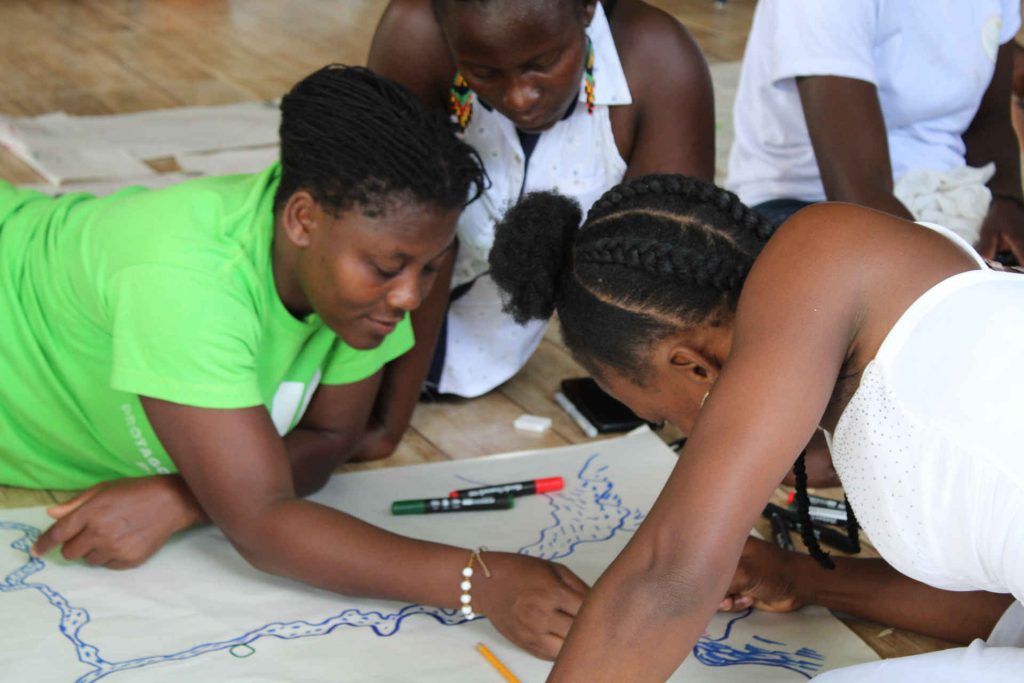
These workshops focused on their collective identity and the impact of violence on their lives and the different actors that operate in their territories and influence violence. People worked in groups to make maps or representations of their communities and talk about the assets and vulnerabilities within their communities.
In order to achieve Aim 2 (“Examine how community members experience this vulnerability while navigating their specific geographical contexts”) we conducted focus groups with different sub populations to understand how people navigate violence and keep themselves safe at different intersects of identity:
Rural Afrodescendent women;
Urban Afrodescendent women;
Rural indigenous women;
LGBTQIA+ young people;
Urban men;
Rural young people;
Social leaders and human rights defenders.
Research participants work in groups to make representations of their communities.
RESEARCH FINDINGS
At the community workshops for Aim 1, we heard repeatedly from indigenous and Afrodescendent participants how important the relationship with the land is to their cultural identities, and how displacement threatens this. For indigenous participants in particular, the greatest fear for many was losing their lands. We also heard about how communities see a link between their stewardship of natural resources and the violence they have experienced because of external interests in extracting those resources.
In the focus groups for Aim 2, we saw that many of the protection strategies being employed by people at different intersects of identity were collective, such as travelling to unsafe places in groups, identifying safe houses, developing relationships with neighbours to look out for each other in the neighbourhood, and discussing travel plans with family and loved ones. We were surprised to note that despite known risks of violence and mistreatment at home for LGBTQ+ people, in our focus group only one participant noted home as an unsafe space, although others commented that feeling safe at home was something they had worked to achieve over time and by being selective in who they lived with.
For our Aim 3 discussions, we heard about how collective strategies like the Puente Nayero humanitarian space in urban Buenaventura and the Humanitarian Shelter of the Wounaan Phobor community provided the safest conditions for residents that they saw available. While residents did not say that they ever felt completely safe, the social cohesion and political organising of these spaces were their most effective protection. These spaces are both supported through internal organising by residents but also by partnerships with external organisations like CONPAZCOL, and through national and international advocacy that bring visibility and international accompaniment to the initiatives.
The territory of the AINI Women’s collective in the Naya river. The flag is a protection measure to visibilize our presence.
Exploring unarmed civilian self-protection in Cameroon’s Anglophone conflict
This research investigated community-led initiatives of unarmed civilian protection in the ongoing ‘Anglophone conflict’ in Cameroon. Subjected to violence from both the military and armed separatist groups, civilians have been pro-active and resourceful in devising ways to protect each other and stay safe, inclusive of coded language, non-verbal communication, direct negotiation with the warring parties, early warning networks and information sharing through local associations and social media. The creation of a culture where ‘everybody is one another’s keeper’ has been crucial in enabling citizens to sustain their lives within the conflict zones since 2016. The role of women and women’s organisations is especially significant. Thus, this research explored bottom-up approaches to UCP, inclusive of their strengthening, and provides an important contribution to knowledge about informal and innovative grassroots efforts of civilian self-protection that involve vulnerable civilians’ own agency. Research methods included arts-based and creative approaches (participatory storytelling, poetry, and drawing) that enable conflict-affected communities to co-create knowledge. The research project was conducted by a team of UK-based and Cameroon-based researchers and practitioners that has previously undertaken successful research on this neglected conflict. The three NGO members are all currently involved in providing humanitarian support to civilians in the conflict zones.
RESEARCH FINDINGS
Unarmed civilian protection in the context of the Anglophone conflict is predominantly led and implemented by local citizens affected by the conflict. Civilians employ a plethora of homegrown and digital unarmed self-protection strategies. We categorise these under three headings – spontaneous measures, early warning and response measures, and preventive measures.
Local agency is critical in the implementation of unarmed civilian protection. Civilians in the Anglophone conflict have been innovative and resourceful in the strategies adopted. Some strategies such as ‘dressing appropriately’ have been rather unique to this conflict, while others such as neutrality and protective silence are seen in other conflicts.
Individuals and communities have largely devised their own self-protection strategies, with support from outside agencies either absent or limited to humanitarian assistance, due to government hostility to any perceived outside interference. Yet community self-protection can potentially be strengthened through enhanced vertical linkages to local and international NGOs. Local NGOs have a role to play in strengthening civilian efforts through funding, capacity strengthening, and partnerships with local community groups. International NGOs can provide financial support to support these activities. Reflection is needed, however, on the appropriate funding model and partnership approach, allowing community self-protection strategies to be supported without the imposition of international NGOs’ preconceived UCP agendas.
Contribution to Knowledge
The study has demonstrated how people in conflict-affected communities are active agents in their own protection, something less commonly covered in the literature. In particular, the study has highlighted the significance of grassroots actors in the provision of UCP. Overall, the study shows that community self-protection measures are important not only in the absence of external actors, but also that such external bodies, both national and international, should learn from the protective measures adopted by local actors, and seek to support and strengthen these. Grassroots actors are most familiar with the terrain and context and play a critical role in their own protection. Therefore, it is essential that outside bodies, especially international organisations, acknowledge this and allow local groups to take the lead in determining the most appropriate community protection measures.
Methodologically, the study demonstrated the relevance and beneficial nature of participatory and arts-based methods. First, creative safe spaces were provided in which participants could share their experiences freely and creatively without fear of possible reprisals. Through drawing, for example, participants found a non-verbal safe space to express their views, emotions, and experiences of the conflict and their unarmed protection strategies. Secondly, this enabled participants to be authors of their own stories and experiences through the creative processes of storytelling, drawing, and poetry writing. Participants felt a sense of pride in demonstrating their ‘hidden’ skills in telling their stories through these mediums.
PI: Prof Gordon Crawford, is Research Professor in Global Development, Centre for Trust, Peace and Social Relations (CTPSR), Coventry University (CU). He is responsible for overall leadership, research design and management of the project, including ethical approval and write-up of research outputs and dissemination.
Co-I: Prof James Kiven Kewir, is a Professor of Conflict Prevention and Regional Integration and Research Hub Leader for Central Africa, African Leadership Centre (ALC), Nairobi, Kenya. He is responsible for organisation and management of all aspects of data collection in Cameroon, and management of Cameroonian team members. Contribution to write-up of outputs and dissemination.
Co-I: Dr Nancy Annan, is an Assistant Professor, at the Centre for Trust Peace and Social Relations (CTPSR), Coventry University (CU). She is responsible for review of relevant secondary literature on UPC and the Anglophone conflict, preparation of interview guides, data transcriptions and analysis using NVivo, project webpage and social media presence. Contribution to write-up of outputs and dissemination. Twitter: @NAnnan_dr
Co-I: Dr Bernard Sakah, is the Managing Director of Big Steps Outreach Network (BONET), Cameroon. BONET is a youth organisation. Responsible for organisation of data collection in the Northwest Region, and a focus on youth participation.
Co-I: Ms Atim Evenye Niger-Thomas, is the Assistant Executive Director, Authentic Memorial Empowerment Foundation (AMEF- https://ameffoundation.org/), Cameroon. She is a PhD candidate in Conflict Management and Peacebuilding at International University of Applied Sciences for Development (IUASD) Sao Tome in partnership with IPD Yaoundé. Responsible for organisation of data collection in the Southwest Region.
Co-I: Ms Zoneziwoh Mbondgulo-Wondieh, is the Executive Director, Women for a Change (Wfac – https://wfaccameroon.org/), Cameroon. She is a PhD candidate at the University of Buea. She is jointly responsible for organisation of data collection, focusing on women’s participation. Facilitator of participatory storytelling workshops.
African Leadership Centre (ALC): ALC at King’s College London and Nairobi are a community of leaders driving peace, security, and development. We offer courses, programmes and research opportunities to inform and influence debate on issues of peace, leadership, development and security. Website:https://www.kcl.ac.uk/alc; https://africanleadershipcentre.org/ Twitter: @ALC_KCL
Big Steps Outreach Network (BONET): BONET is a youth led non-profit making organization created in 2010 and has been involved in activities including governance, democracy, human rights, sexual reproductive health and rights, community education, empowerment and entrepreneurship as well as humanitarian interventions across Cameroon. Facebook: https://www.facebook.com/BigStepsOutreachNetwork Website: www.bonetweb.org Twitter: @bigstepoutreach
Authentic Memorial Empowerment Foundation (AMEF): AMEF is a Non-Governmental Organization (NGO) created in 2006 and legalized in 2008 with a vision to cater for the rights of the girl child, young girls, and women entrapped by gender-based violence. AMEF runs four core programs namely; Education and Child Protection (ECP), Economic Development and Livelihood (EDL), Gender, Protection and Peace (GPP), Health/Nutrition/ WASH (HNW) Website: www.ameffoundation.org, Facebook: Amef Kumba-cameroon, Twitter: @AtimEvenye, @amef_kumba
The Cameroon Anglophone Crisis Database of Atrocities (CDOA): CDOA held at the University of Toronto, is an organization that documents and investigates human rights abuses in the context of Cameroon’s Anglophone Crisis. The Database of Atrocities uses open-source intelligence methods and geospatial expertise to verify incidents, working with trained university teams around the world. Website: https://research.rotman.utoronto.ca/Cameroon/ Twitter: https://twitter.com/cameroondoa
Nonviolent Artivism Against Police Brutality in Kenya
A mural of police brutality in Kibra’s Kamukunji grounds by Detail Seve on June 4, 2020. Image: MERCY MUMO
This research explored youth and civil society nonviolent artivism against police brutality in two Kenyan locations: Nairobi and Kisumu. “Nonviolent artivism” here includes the use of wall paintings and pictures (murals, graffiti, and visual art), spoken word, poetry and music, when they are used as unarmed civilian protection strategies.
Over the years, there have been advocacy initiatives and public demonstrations against police brutality. The demonstrations have often been met with brutal force from the police, sometimes leading to deaths of civilians. For example, in 2020 there were 109 demonstrations and protests on diverse social issues of concern. The demonstrations were in compliance with the law of the constitution which gives citizens the right to self-expression and peaceful public demonstrations. Despite this, there were 9 deaths that were directly attributed to excess use of force by the police and 113 unlawful arrests.
Many civil rights groups have realized that direct physical demonstrations against the police often have a negative impact and bear a high risk of police brutality. As an alternative, artivism was adapted as a strategy for unarmed civilian protection against brutality. This research has taken a special interest in studying artivistic strategies applied by both the youth and civil society organizations and exploring the extent to which these strategies have succeeded in reducing incidences of police brutality.
RESEARCH TEAM
Martha Okumu, Peace Tree Network (principal investigator)
Elias Opongo, Hekima University College
PROJECT OUTPUTS
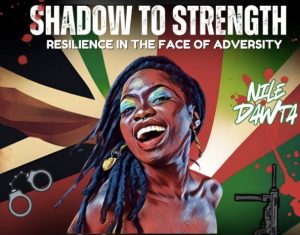
Shadow to Strength: Exhibition, performances, and discussions
In December 2024, the project team organised the exhibition and event “Shadow to Strength: Resilience in the Face of Adversity” in Nairobi’s Kenya National Theatre.
This documentary captures highlights of the event as well as reflections of its organisers and participants.
There is also a series of short videos capturing some of the artistic highlights from the exhibition and performances.
The event also featured a panel discussion on artivism against police brutality in Kenya, which you can listen to in this video.
Song/Poem: When a young blood bleeds
This song/poem was written by Spontaneous the Poet, and recorded as part of this project. Spontaneous the Poet says, “This piece was written in remembrance of people who’ve lost their relatives from extra judicial killings. It is actually based on a true story and I’m so grateful that they took part in the shooting of the video.”
Images of artwork
This project has produced images of artwork related to police brutality in Kenya. Some of these have been shown as part of the Creating Safer Space exhibition, which has toured around the world and is also available to view online as a virtual 360° Exhibition.
These murals were made by a local community-based organisation that works on defending human rights in Kisumu, in order to create awareness on having a peaceful election before, during and after general elections in 2022. For more images, see the Creating Safer Space virtual 360° Exhibition.
RESEARCH SUMMARY
In carrying out this research, we undertook the following activities:
Key informant interviews: A total of 56 respondents were interviewed. These respondents were youth and women community leaders, artists, victims and survivors of police brutality, CSO members, Police Officers and Judiciary Staff.
Focus group discussions (FGDs): We conduced 3 FGDs with two being held in Nairobi and one in Kisumu. A total of 36 respondents took part in these discussions.
Validation workshop: Our final research activity was the validation workshop, which was held in Nairobi. We presented the research findings for validation to 14 research respondents from Nairobi and Kisumu.
From our research analysis, we found that respondents had experienced some form of police brutality at a personal level or through family members. The major forms of police brutality experienced included:
Excessive use of force by the police while undertaking their duties;
Extra judicial killings by the police especially in low-income areas;
Arbitrary arrest;
Torture;
Excessive use of teargas;
Beating of civilians;
Shooting of civilians;
Some respondents had experienced all of the above.
Role of artists in addressing police brutality in Kenya:
By employing their creative abilities to spread awareness, spark debate, and promote change, artists significantly contributed to the effort to combat police brutality in Kenya. Our research sought to understand the techniques employed by Kenyan artists to help raise awareness of cases of police brutality, and to promote change by addressing incidences of police misconduct.
The respondents identified four major roles that artists play to help address police brutality in Kenya, namely:
They act as a mirror to the society;
They create awareness on issues of police brutality;
They show solidarity to the victims of police brutality;
They shape knowledge on how to deal with cases of police brutality.
Successful artivism strategies used to address police brutality:
Poems/spoken word
Music
Plays
Graffiti
Cartoons
It is important to note that the success of the above strategies varied depending on the location of the research.
Strengthening Local Capacities for Unarmed Civilian Protection in Uasin Gishu, Kenya
Research activities with community members in Uasin Gishu
This project sought to generate new, evidence-based knowledge and understanding regarding civilians’ agency in local conflict transformation processes in Kenya’s Uasin Gishu County. The research was conducted in three urban hotspot areas of Uasin Gishu, which have been at the centre of heated political contests in recent electioneering periods (2013 and 2017 general elections) and were adversely affected by the 2007-2008 post-election violence.
Using participatory methods such as the People-First Impact Method (PFIM) and Community Scorecards, the project explored existing and emergent local civilian protection systems and the related civilian knowledge and/or capacity gaps that need to be addressed to bolster them. Its findings provide a local and contextual understanding of the dynamics of unarmed civilian protection (UCP) in Uasin Gishu, the role played by civilians/civilian groups in local peace processes and protection systems, and how UCP in Uasin Gishu feeds into county and national security organs.
The project aimed to achieve the following outcomes:
Enhanced knowledge on existing and emergent local civilian protection systems in Burnt Forest, Langas and Turbo;
Improved knowledge on civilian capacity gaps regarding unarmed civilian protection in Burnt Forest, Langas and Turbo;
Improved knowledge on the intersectionality between international, national and local (self-protection) civilian protection mechanisms.
Research activities in Uasin Gishu
RESEARCH TEAM
Clinton Gwako, Rural Women Peace Link (principal investigator)
Civilian (Self-) Protection from Violent Conflict in Papua
Exploring Local Infrastructures and Initiatives
Violent conflict has been ongoing in Papua, Indonesia, since the 1960s. Our research studied the vulnerability of the Papuan people to physical harm, local actors’ initiatives to protect civilians, and their mechanisms to share those initiatives with other civilian actors. The aim of the project was to support and strengthen the capacity of local organisations to promote and build civilian protection mechanisms, in order to promote community-based conflict and peace management.
The project has produced 12 podcasts related to civilian protection in Papua and related topics, which are available here.
Interview
Arfiansyah, the co-investigator of the project, was interviewed on Sagoe TV Podcast. Arfiansyah discussed his research activities with Nonviolent Peaceforce of the Philippines in Papua, in Maesot on the Thai border with Myanmar, and in Kachin and Northern Shan states of Myanmar, with an emphasis on the research in Papua.
Opinion Piece
The project published an opinion piece in Jakarta Post, entitled ‘A new approach to violent conflict in Papua’, on 5 March 2024. The article is written by Arfiansyah and Delsy Ronnie, and it argues that recognizing and allowing a nonpartisan third party to focus solely on protecting civilians from violent conflict could be a stepping stone to conflict management in Papua. The article is available here:
The project has disseminated its research to Indonesian military officers. This was part of a training programme on International Humanitarian Law and Human Rights facilitated by the National Human Rights Commission. More information is available here.
Introducing Unarmed Civilian Protection in Thai Society: Opportunities and Challenges
Thailand is a country that is presently experiencing different kinds of violence, from the low-intensity conflict in the Deep South, to violence surrounding political protests, and to environmentally based conflicts with tribal ethnic groups. The state’s application of emergency law, martial law, national security law, and the persistent impunity in the security sector, have resulted in a situation in which protection mechanisms by the state are not adequate.
This research had the following questions/objectives:
To demonstrate that protection of civilians can also be done by civilians, and that unarmed protection can be learned.
To explore the opportunities and challenges of UCP practices in the Thai conflicts and political context.
To reiterate that UCP is part of conflict management and nonviolent struggle.
To compile, define, and analyse patterns of civilian protection practices in various conflict situations.
To identify the conditions and the social and political environments affecting UCP practices.
To design communication channels and a social learning platform for UCP.
RESEARCH TEAM
Chantana Wungeao, Peace and Conflict Studies Center, Chulalongkorn University, Thailand (principal investigator)
Mark Tamthai, Strategic Nonviolence Working Group, Thailand (co-investigator)
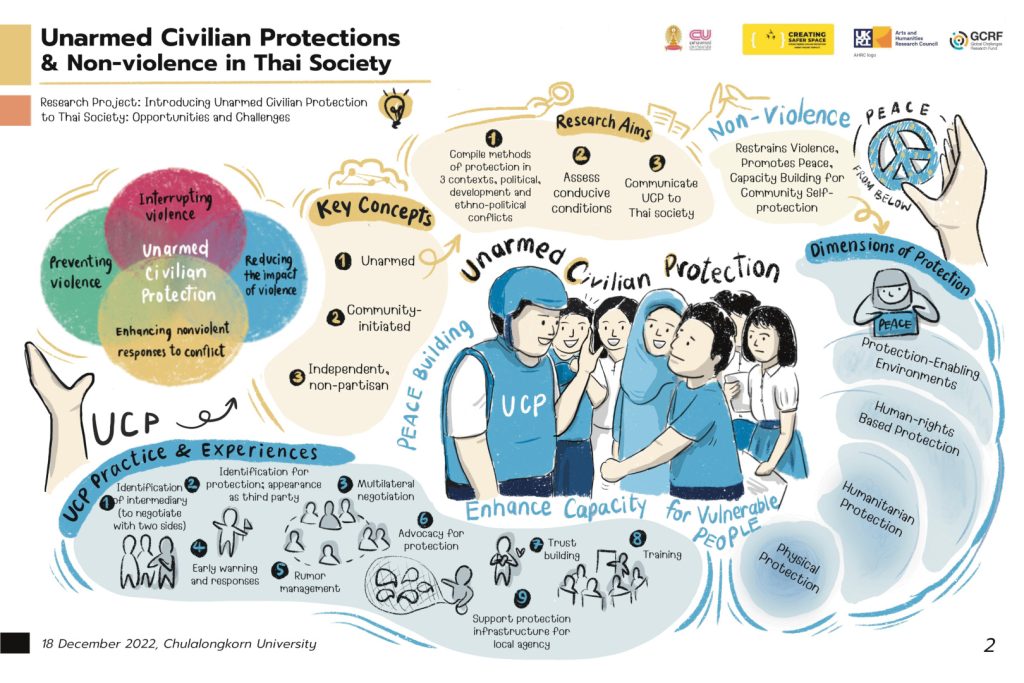
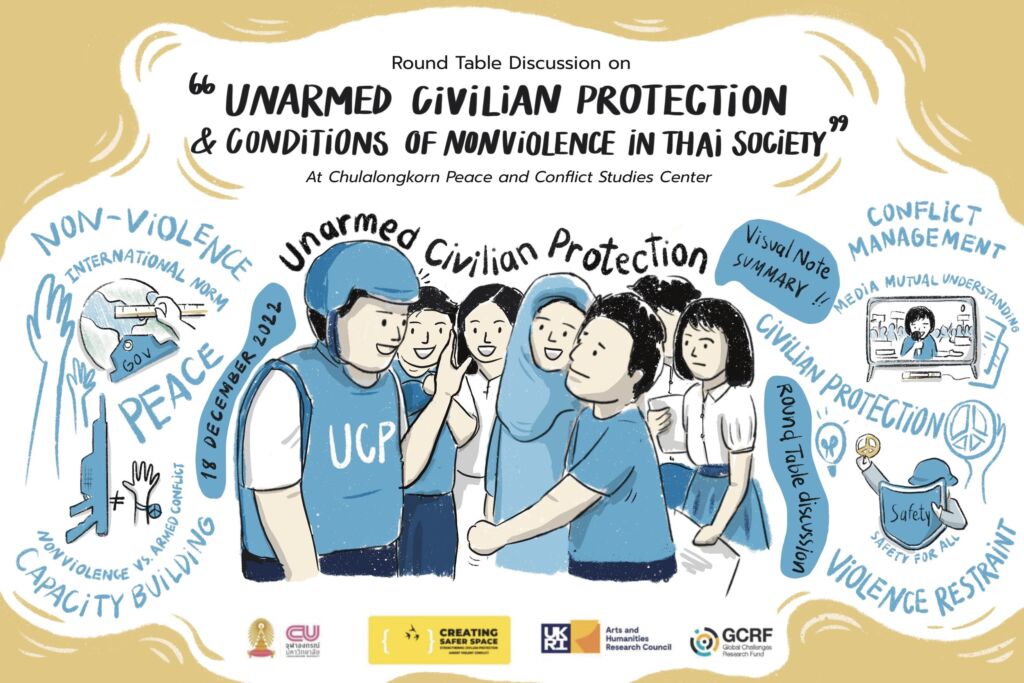
A visual note summary of the roundtable discussion “Unarmed Civilian Protection and Conditions of Nonviolence in Thai Society” at Chulalongkorn Peace and Conflict Studies Center, December 2022. Illustrated by Wanwisa Intarakanchit.
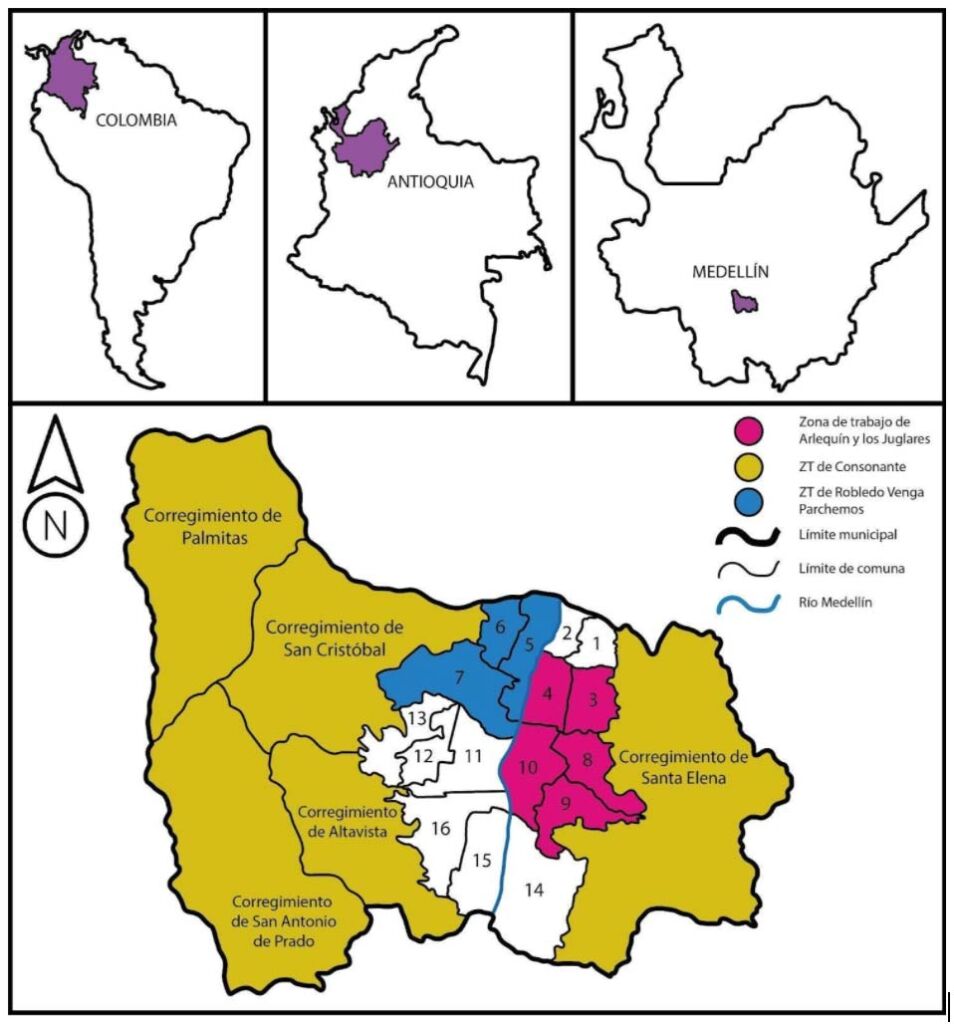
Art that Protects, phase 1: Contributions of artistic-cultural initiatives to the self-protection strategies of young people and women in the context of the urban conflict in Medellín, 2022
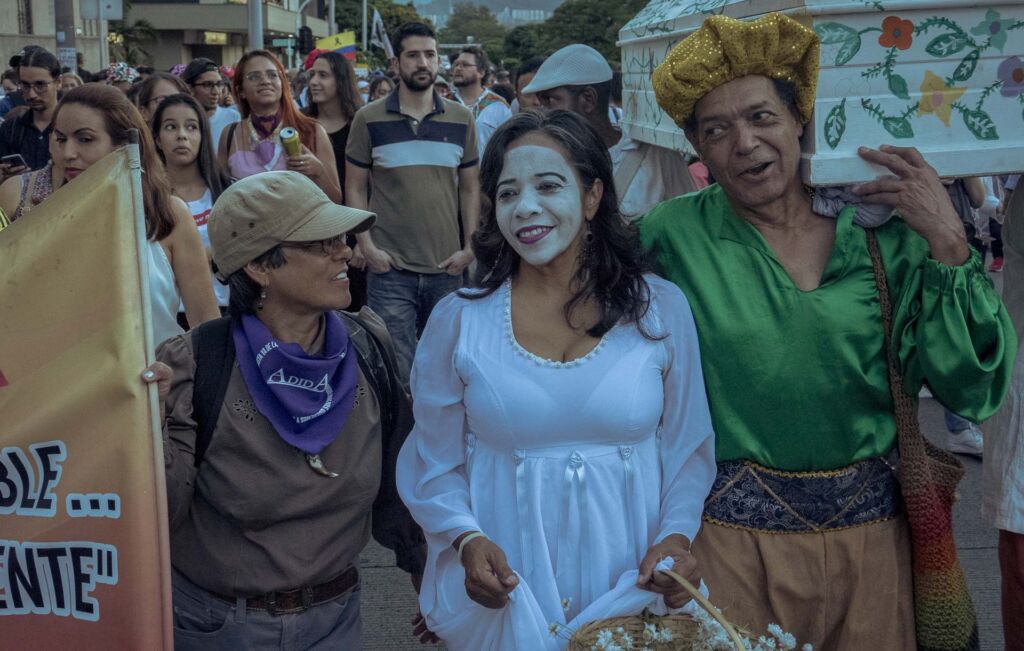
Harlequin and the Jugglers (photo: Raul Soto)
This project focused on two issues less explored in the existing literature on civilian self-protection: first, how forms of self-protection are related to urban conflict-related violations, with an emphasis on women and youth; and second, what place and meaning artistic and cultural practices developed by community-based organisations take in forms of self-protection. The research was carried out in the city of Medellin, Colombia, in collaboration with artistic and cultural organisations active in neighbourhoods affected by urban violence (central, north-eastern and north-western communities, as well as peri-urban districts). Exploring these questions allowed us to re-dimension the concept of civilian self-protection and its strategic possibilities for a better living of urban communities.
RESEARCH TEAM
Beatriz Arias López, Universidad de Antioquia (principal investigator)
Adriana Diosa, Cultural corporation for development Arlequín y los Juglares
Giovanni Pérez Cárdenas, Cultural corporation for development Arlequín y los Juglares
Katherne Urrea Velásquez, Robledo Venga Parchemos
Jeimy Catalina Guerra Correa, Corporación Consonantes
PROJECT OUTPUTS
Recording of La Fiesta theatre production, performed at Pablo Tobón Uribe Theatre of Medellín on 17 May 2023 (more information in English and Spanish). La Fiesta is written by Óscar Manuel Zuluaga and performed by Harlequin and the Jugglers.
Arte Que Protege music video by Gio Monteadentro.
Art: A social outburst song and video, introducing the context of the research project. For translation of the video, please choose first Spanish subtitles (click on the cog symbol) and then your language by clicking on auto-translate.
Arias López, Beatriz E., Laura Jiménez Ospina, Freddy Peréz Cardenas G., and Berit Bliesemann de Guevara, ‘Art That Protects’, Humanitarian Exchange, 82.12 (2023).
UdeA Noticias, “Cuatro murales, huellas del arte que protege en Medellín” (“Four murals, traces of the art that protects in Medellín”) https://bit.ly/ArProUdeA
Map of the research areas (based on interviews with project partners)
{ Argelia, rio La Paloma }
{ Argelia, río La Paloma El Zancudo }
Water conflicts, violations and forms of self-protection, phase 1
A multi-case study in Eastern Antioquia, Colombia
Socio-environmental conflicts are understood as those arising from the contradiction between antagonistic forms of appropriation, productive management, distribution and significance of nature. This research project focused on water as the structuring axis of hydro-social relations and on the conflicts that arise over its control and use. It sought to document the environmental conflicts related to concession processes for hydroelectric projects on the rivers La Paloma, Santo Domingo and Dormilón, with emphasis on three municipalities in Eastern Antioquia (Colombia) – Argelia, San Francisco and San Luis – in order to recognise both the particular forms of violation and their actors, as well as the self-protection strategies deployed by the inhabitants and organizations.
IX Festival del Agua, Sonsón, 2017
RESEARCH TEAM
Beatriz Arias López, Universidad de Antioquia (principal investigator)
Hernán Dario Pineda Gómez, Universidad de Antioquia
Mateo Valderrama, Asociación Campesina de Antioquia – ACA
Juan David Arias, Grupo De investigación Territorio, Universidad Pontificia Bolivariana
Jessica Restrepo, Grupo De investigación Territorio Universidad Pontificia Bolivariana